


How Video Translation Services Can Expand Your Business Globally

Video translation services are not just localization tools—they are a growth infrastructure that compounds SEO visibility, reduces acquisition costs, and unlocks defensible global revenue when executed strategically.
Video translation expands your business globally by increasing the total addressable market, improving conversion rates in non-English regions, strengthening SEO and AI search visibility, and building localized trust that competitors often ignore.
Most companies still treat translation as a marketing afterthought. That is the problem.
What Is Video Translation?
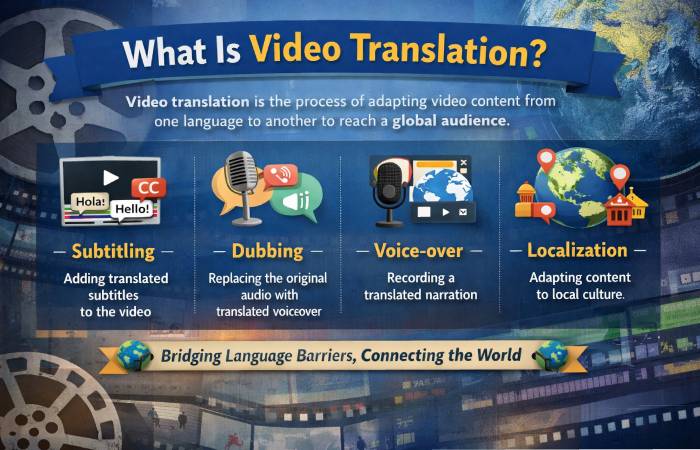
Video translation is the process of adding subtitles to a video in a language other than the one used by the actors or voiceover. For example, if your video features an employee demonstrating your product’s functionality in English, you might use a translation service to add German captions. From there, you can distribute your subtitled video in Germany and engage German-speaking audiences.
What Video Translation Services Actually Include
Many businesses assume video translation means “adding subtitles.” That is only one layer.
Core Components of Video Translation
| Component | What It Includes | SEO Impact | Conversion Impact | Cost Level | Best Used For |
| Subtitling | Translated captions synced to speech | High (indexable text) | Moderate | Low | Market testing |
| Closed Captioning | Includes non-verbal cues | Moderate | Moderate | Low | Compliance & accessibility |
| Voiceover | Narration layered over original audio | Moderate | High | Medium | Educational & explainer content |
| Dubbing | Replacing original speaker | Moderate | Very High | High | Core international markets |
| Transcription | Text version of speech | Very High | Indirect | Low | SEO expansion |
| Full Localization | Cultural adaptation of script & visuals | High | Very High | High | Long-term expansion |
The deeper the adaptation, the stronger the potential conversion lift.
Translation vs Localization — Why It Changes Revenue
Translation changes language. Localization changes perception.
Strategic Differences
| Factor | Direct Translation | Full Localization |
| Tone | Literal | Culturally adapted |
| Messaging Style | Same across markets | Adjusted for regional norms |
| Units & Currency | Often ignored | Properly converted |
| Humor & References | Unchanged | Adapted |
| Trust Level | Moderate | High |
| Long-Term Brand Impact | Limited | Strong |
Illustrative Scenario: E-commerce Brand
Version A – Direct Translation
- Literal script translation.
- Same call-to-action style.
- No cultural nuance.
Version B – Localized
- Region-specific tone.
- Adapted product examples.
- Adjusted pricing references.
Result:
Version B reduces friction and improves confidence.
Harvard Business Review has frequently discussed how cultural resonance affects purchasing decisions. Localization supports that resonance.
The Global Revenue Multiplier Framework
Video translation compounds across three layers:
Traffic Expansion × Conversion Lift × Retention Strengthening
Instead of focusing only on views, evaluate the entire revenue equation.
Before vs After Localization
| Metric | Before Translation | After Subtitles | After Full Localization |
| Regional Traffic | Moderate | Same | Same |
| Watch Time | Low | Higher | Highest |
| Conversion Rate | Low | Medium | High |
| CAC | High | Reduced | Optimized |
| Refund Rate | Moderate | Slightly Lower | Significantly Lower |
| Retention | Average | Stable | Improved |
Even small percentage improvements in conversion rate compound when applied across new markets.
SEO & AI Search Advantages
Search engines rely on structured signals. Translated transcripts provide exactly that.
Multilingual SEO Impact
| SEO Element | Without Translation | With Translation |
| Keyword Coverage | Single language | Multi-language indexing |
| Search Intent Matching | Limited | Region-specific |
| Long-tail Visibility | Weak | Expanded |
| Backlink Potential | Narrow | Global |
| AI Overview Eligibility | Lower | Higher |
Google documentation stresses serving content in users’ languages rather than relying solely on automated translation tools.
AI Search & Overviews
AI-driven search systems:
- Synthesize structured content.
- Pull from transcripts and metadata.
- Prioritize context-rich material.
Translated transcripts increase semantic coverage, making your content more likely to surface in AI summaries.
In an AI-driven search environment, language diversity increases surface area.
Choosing the Right Format: Subtitles vs Voiceover vs Dubbing vs AI
Not every business needs dubbing immediately. Strategic sequencing matters.
Format Comparison
| Format | Cost | Speed | Engagement | Scalability | Best Phase |
| Subtitles | Low | Fast | Moderate | High | Testing markets |
| Voiceover | Medium | Moderate | High | Medium | Validated regions |
| Dubbing | High | Slower | Very High | Low | Core markets |
| AI Voice Cloning | Low–Medium | Very Fast | Improving | Very High | Scale stage |
Phased Rollout Strategy
- Test top-performing videos with subtitles in 1–2 regions.
- Measure watch time and conversions.
- Upgrade to voiceover in validated markets.
- Invest in dubbing where ROI justifies it.
This protects capital while preserving upside potential.
Market Entry Playbook
Identify High-Potential Regions
Evaluate:
| Data Source | What to Look For |
| Google Analytics | Traffic by country |
| YouTube Analytics | Watch time by region |
| Paid Ads | Conversion rate by language |
| CRM | Inbound international leads |
Start where demand already exists.
Localize High-Leverage Content
Prioritize:
- Product demos.
- Onboarding explainers.
- High-converting ad creatives.
Avoid translating low-impact assets first.
Align Supporting Assets
Translating video but not landing pages creates friction.
| Asset | Must Be Localized? |
| Video | Yes |
| Landing Page | Yes |
| Pricing Page | Ideally |
| FAQs | Recommended |
| Email Follow-ups | Strongly Recommended |
Consistency builds trust.
Track Region-Specific KPIs
| KPI | Why It Matters |
| Watch Time by Language | Engagement indicator |
| Conversion Rate | Revenue validation |
| CAC | Efficiency metric |
| Churn/Refund Rate | Clarity & trust indicator |
| Revenue by Region | Market traction proof |
Industry-Specific Applications
SaaS
| Use Case | Impact |
| Demo Videos | Higher regional demo requests |
| Onboarding Tutorials | Reduced churn |
| Feature Announcements | Better product adoption |
E-commerce
| Use Case | Impact |
| Product Explainers | Fewer returns |
| Installation Videos | Increased confidence |
| Social Ads | Better CTR |
EdTech
| Use Case | Impact |
| Course Modules | Better comprehension |
| Certification Training | Broader enrollment |
| Webinar Replays | Global reach |
Healthcare & FinTech
Regulatory nuance matters:
- GDPR (EU data regulations).
- HIPAA-related considerations in the US.
Translation errors in regulated industries can affect compliance and credibility.
Common Strategic Mistakes
| Mistake | Risk | Prevention |
| AI-only translation | Cultural errors | Human review layer |
| Translating video only | Landing page mismatch | Full funnel localization |
| Expanding too fast | Budget waste | Phased rollout |
| Ignoring keyword research | Weak SEO | Local search analysis |
| Not measuring regional metrics | Blind scaling | Region-specific dashboards |
Avoid overconfidence in automation. Nuance still requires oversight.
The Future: AI + Human Hybrid Localization
AI technology enables:
- Real-time dubbing.
- Voice cloning.
- Automated subtitling.
However, AI struggles with:
- Humor.
- Cultural nuance.
- Compliance language.
Hybrid Model Benefits
| Element | AI Role | Human Role |
| Speed | Rapid draft translation | Review & refine |
| Scale | Multi-language deployment | Cultural adjustment |
| Cost Efficiency | Lower baseline cost | Quality assurance |
| Brand Voice | Approximate | Protect & align |
This hybrid model creates scalable yet defensible localization.
Conclusion
Video translation services expand global business not merely by increasing reach, but by compounding visibility, trust, conversion, and retention across markets.
When executed strategically, localization:
- Lowers CAC.
- Increases conversion rates.
- Improves AI search visibility.
- Builds first-mover advantage in emerging regions.
In a digital ecosystem where video dominates and AI search is evolving rapidly, multilingual video is no longer optional.